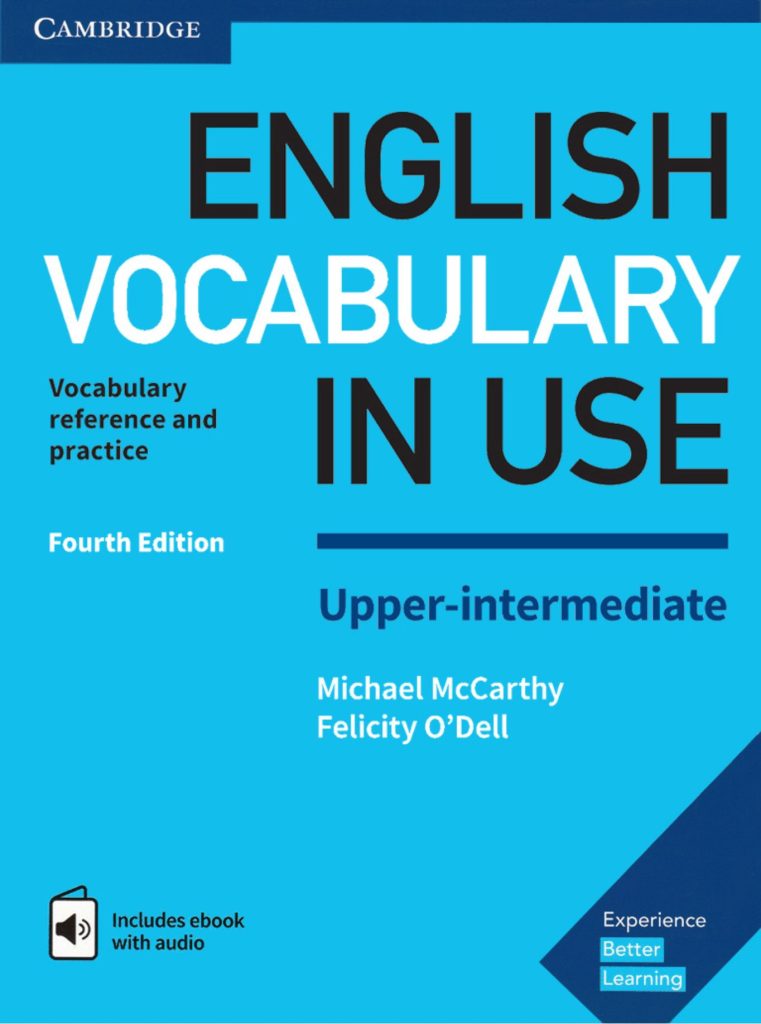
About This Book
English Vocabulary in Use Upper Intermediate is the upper-intermediate level of the In Use family’s vocabulary line. The destination heading gives the exact title (its address carries another book’s slug — a crossed address on the host; the heading and the file govern, per this list’s rule); the file served there, ‘English Vocabulary in Use Upper Intermediate.pdf’, carries the exact title itself — the same volume under the filename the site serves it by. The book’s work is bridging: from the vocabulary of daily survival to the vocabulary of educated participation.
Upper-intermediate is the most consequential and least celebrated stage of language learning. The learner can live in English — shop, travel, chat — and stands before the doors that vocabulary alone unlocks or bars: the examination essay, the job interview, the university seminar, the serious newspaper. What those doors demand is a specific stratum of words: not the exotic, but the articulate middle — the verbs of argument, the nouns of abstraction, the adjectives of judgement — together with the collocations that make them sound native rather than assembled. A bridge volume in the In Use manner builds that stratum the family’s way: thematically, contextually, with the items shown in the sentences where they earn their keep, and practised until they are available under pressure, which is precisely where examinations and interviews test them. Its quiet promise is leverage: each strong word learned here is spent a thousand times, in every essay, meeting, and application the learner will ever write. That compounding is why this stage, diligently stocked, changes trajectories rather than merely grades.
What Learners Will Practise
The Articulate Middle
Learners practise the vocabulary of argument and abstraction — the stratum educated English actually runs on. These are the words that turn opinions into positions.
Collocation at Speed
The book practises producing the partnerships fluently, under the mild pressure exercises apply, because interviews and examinations do not wait. Available-under-pressure is the only ownership that counts there.
Register for Rooms That Matter
Readers practise the formal-neutral register of essays, applications, and professional exchange. Knowing which tone a room expects is vocabulary knowledge wearing its social face.
Key Features
The bridge design is the feature: survival vocabulary extended into educated currency, in the In Use teach-then-practise design. The leverage selection is the second — words spent a thousand times — and the shelf fit the third, the bridge beside this list’s advanced and pre-intermediate volumes. On this shelf it builds the bridge here.
Who This Book Is For
Upper-intermediate learners aiming at examinations and advancement are its first audience. Teachers form its second readership, preparing classes for the next stage. Professionals make its third, whose English is entering judged rooms.
How to Use This Book
Learn in themes and immediately write with the spoils — a paragraph per unit, in your own argument. Collect collocations, not single words, in your notebook. Revisit under time pressure occasionally; fluency is knowledge that survives a clock.
Related Books
The series’ advanced volume stands at English Vocabulary in Use Advanced, and the shelf’s pre-intermediate volume at English Vocabulary in Use Pre Intermediate.