About This Book
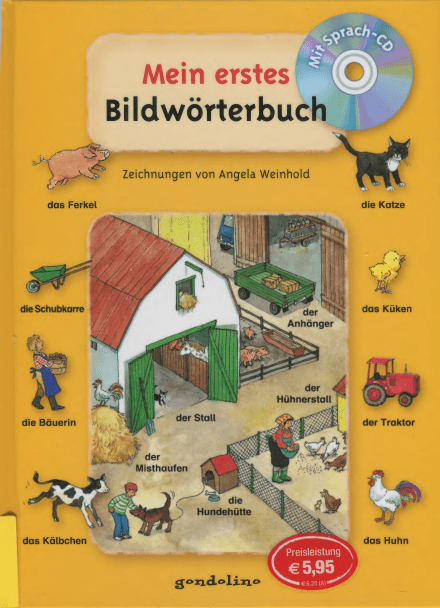
Mein erstes Bildwörterbuch — My First Picture Dictionary — is a children’s dictionary in which every word arrives with its picture: German vocabulary presented visually, scene by scene, for the youngest learners. It stands at the absolute head of the dictionary tradition, before definitions exist, when the bond between a word and the world is still made by pointing.
The picture dictionary’s simplicity conceals a complete theory of learning. A definition explains a word with other words — useless to a reader who has few — while a picture explains it with the world, which the child already knows. What is being taught, then, is pure naming: the German label attached to the recognised thing, in scenes that mirror the child’s own day, so the new language is absorbed as a second skin over a familiar world rather than as a foreign system. The ‘first’ in the title is also a promise about sequence — this is where the collection’s whole dictionary shelf begins, the ancestor of every frequency list and learners’ dictionary above it, and for many children their first experience of a book as a tool that answers questions: what is that called? It is called this. In German, it is called this.
What Learners Will Practise
Naming the World
Children practise the foundational act: seeing a thing, saying its German. The pictured scenes make the practise a game of pointing and naming that adults can join without knowing German themselves — the picture mediates — so vocabulary grows at the speed of the child’s curiosity about their own surroundings.
Categories and Scenes
The dictionary’s organisation teaches as much as its words: things arrive in their families — the kitchen’s citizens together, the farm’s together — and children practise the mind’s filing system along with the language’s labels. A word learned inside its scene carries its neighbours with it, and recall brings the whole picture back.
First Dictionary Habits
Young readers practise using a reference book itself: finding a page by its scene, hunting a word they half-know, checking what a thing is called. These are the lifelong dictionary skills in their nursery form — the look-it-up reflex that every later stage of German, and of learning generally, will quietly depend on.
Key Features
The picture-word bond is the feature: no definition barrier between the child and the meaning. The scene organisation is the second — vocabulary filed as the child’s world is filed — and the first-book design the third, a volume meant to be owned, carried and worn out by its reader. In this collection it is the German shelf’s ground floor: where the language is first touched.
Who This Book Is For
Young children are its first readers — beginners in German, in reading, or in both at once. Parents form its second readership, given a book they can teach from without speaking the language. Kindergartens and early classrooms make its third: the picture dictionary is the one reference work a five-year-old can operate alone.
How to Use This Book
Keep it where the child lives, not where books are kept: open on the kitchen scene at breakfast, carried to the window for the street. Name things in German as they are met in the day, and let the child quiz the adults — reversal is mastery announcing itself. When the scenes are exhausted, graduate the habit, not just the book: the child who owns this dictionary is ready to want the next one.
Related Books
Stories carry the first words further at Learn German German for Kids–Bilingual Stories in English and German, and the frequency road’s first milestone for older beginners stands at First 200 Words in German.