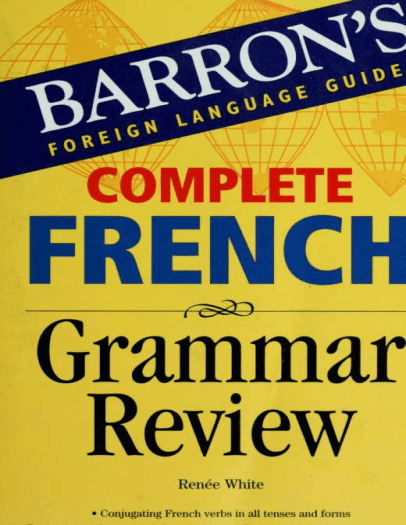
About This Book
Complete French grammar review takes the entire French grammatical system — verbs and their tenses and moods, agreement, pronouns, the article system, sentence architecture — and presents it in review form: condensed, organised and paced for recognition rather than first discovery. The genre has a distinct contract with its reader. Nothing is introduced as if new; everything is restored as if remembered. Explanations are written at the density a returning learner can absorb, with the emphasis placed where disuse does its damage: on the connections between rules, the contrasts that fade first, and the exceptions that time promotes in memory from footnotes to false rules.
The completeness matters because forgetting is not uniform. One returner’s subjunctive survives while their pronouns have dissolved; another’s tenses are intact and their agreements are folklore. A partial review would gamble on which is which. The complete survey removes the gamble, walking the whole territory in order so that every learner’s private pattern of loss is found and repaired in a single pass — and the system, seen whole again, begins to maintain itself, each restored rule propping up its neighbours the way it did when the learner’s French was young.
What Learners Will Practise
Recognition Into Command
The review’s central practice is converting ‘I recognise this’ back into ‘I can produce this’ — the gap where returning learners actually live. Each rule is met first as memory, then exercised as production until the feeling of familiarity is replaced by the fact of ability. The conversion is faster than first learning, which is the returner’s consolation, but it is not automatic: familiarity left unexercised is just nostalgia with good pronunciation, and this book insists on the exercise.
Gap-Hunting
Learners practise diagnosis: sweeping the whole system to locate the specific districts disuse has emptied. The hunt is the review’s intelligence work — most self-taught refreshers waste months re-polishing their strengths, because strengths are pleasant to practise. A complete survey, taken in order and honestly, refuses the flattery: the gaps announce themselves precisely where the learner’s attention tries to hurry, and the book’s structure makes those places impossible to skip unseen.
The System Reconnected
Rules first learned in separate school terms are practised as one machine again: tense answering mood, pronoun answering agreement, the article system running beneath them all. Returners consistently report that this reconnection, more than any single rule restored, is what brings the language back — French stops feeling like a hundred memorised verdicts and resumes being a system the mind can operate, improvise within, and trust.
Key Features
The completeness is the feature: the whole grammar surveyed in one pass, no district skipped, no gap left to chance. The review pacing is the second — density calibrated for recognition, not discovery — and the production insistence the third, memory always converted into output before the survey moves on. In this collection it is the French shelf’s restoration workshop: old fluencies brought in faded and driven out working.
Who This Book Is For
Returners are its first readers — the formerly fluent, the once-examined, everyone whose French is a house they own but have not entered in years. Students approaching comprehensive examinations form its second readership, using the survey as the final consolidation it is designed to be. Teachers make its third: a complete review at the elbow keeps the taught rule and the true rule identical, which students can smell when they are not.
How to Use This Book
Take the survey in order the first time, marking every place recognition fails to become production — your marks are the real table of contents for your second pass. Produce aloud and in writing throughout; silent reviewing manufactures the nostalgia this book exists to cure. When the survey is complete, keep the book in rotation quarterly for a year: a system reviewed on a schedule stays reviewed, and the second year’s French will maintain itself on a fraction of the first year’s effort.
Related Books
The same grammar taught without the hang-up lives in La grammaire sans complexe, and its compact short form stands in the Langenscheidt Kurzgrammatik Franzosisch Fur A1-B2.